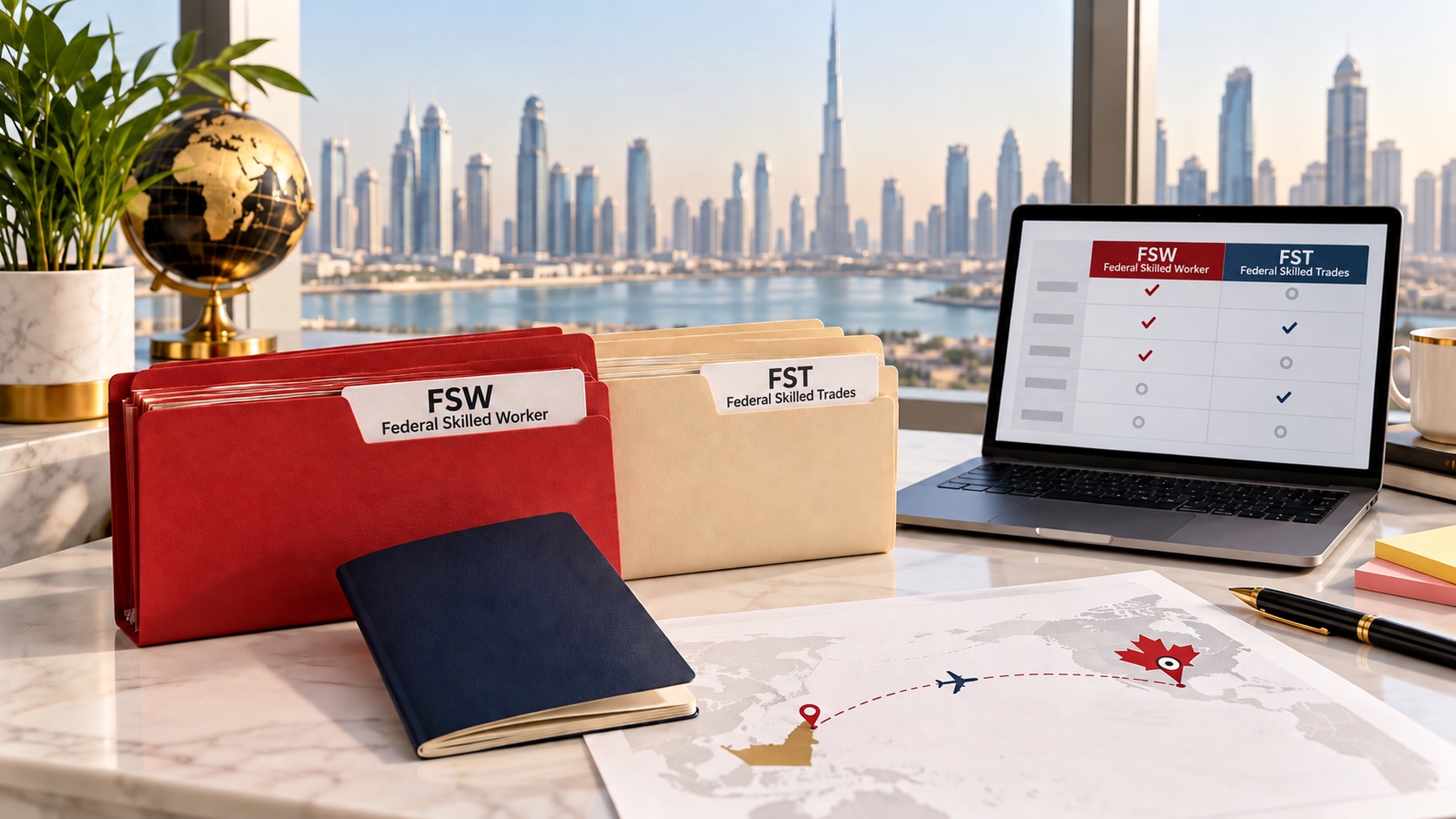
Direct answer: Federal Skilled Worker is usually the first Express Entry route to test if you are a UAE-based professional with continuous skilled work experience, education, language results and settlement funds. Federal Skilled Trades is usually narrower: it fits applicants qualified in specific skilled trades who can show two years of trade experience and either a valid Canadian job offer or a Canadian certificate of qualification. Both routes still depend on Express Entry eligibility, CRS ranking, invitation rounds, a complete permanent residence application and IRCC's final decision. Neither route guarantees an invitation, approval or processing time.
The core difference
Federal Skilled Worker and Federal Skilled Trades are not separate Canadian visas sold by agencies. They are two of the three federal skilled-worker programs managed through Express Entry. IRCC's Express Entry overview, checked for this article on September 18, 2026, explains that candidates create a profile, enter the pool, may receive an invitation in a round, and then submit a permanent residence application.
The practical split is evidence.
Federal Skilled Worker, often shortened to FSW, is broad. IRCC's Federal Skilled Worker page, checked on September 18, 2026, says it is for skilled workers with foreign work experience who want to become permanent residents. It tests TEER 0, 1, 2 or 3 skilled work, language ability, education and a 67-point selection grid before the candidate competes under the Comprehensive Ranking System.
Federal Skilled Trades, often shortened to FST, is specialized. IRCC's Federal Skilled Trades page, checked on September 18, 2026, says it is for skilled workers who want permanent residence based on being qualified in a skilled trade. It focuses on defined trade NOC groups, two years of trade experience, language minimums and either a valid job offer or a Canadian certificate of qualification.
Current search results for "Federal Skilled Worker vs Federal Skilled Trades Program" are mostly comparison explainers, Express Entry stream tables and skilled-trades guides. Many pages list the minimum requirements. Fewer explain the real decision for Dubai and UAE applicants: whether your proof is stronger as a general skilled worker from abroad or as a qualified tradesperson with a Canadian job-offer or certification path.
IN Immigration's permanent residence service overview and skilled worker strategy page are useful background if you are screening a profile before paying for tests, credential assessments, job-search services or representation.
Quick comparison
| Factor | Federal Skilled Worker | Federal Skilled Trades |
|---|---|---|
| Best fit | Professionals and skilled workers with foreign or Canadian TEER 0-3 work, education and language results. | Tradespeople in specific NOC trade groups who can show qualification in the trade. |
| Minimum work experience | At least one year of continuous paid full-time skilled work, or equivalent part-time, in the same primary occupation within the last 10 years. | At least two years of paid full-time skilled-trade work, or equivalent part-time, within the five years before applying. |
| Occupation scope | TEER 0, 1, 2 or 3 occupations. | Specific TEER 2 or 3 skilled-trade groups, including many construction, transportation, manufacturing, natural resources, agriculture, chef, cook, butcher and baker roles. |
| Language baseline | IRCC lists CLB 7 in all four abilities. | IRCC lists CLB 5 for speaking and listening, and CLB 4 for reading and writing. |
| Education | Secondary education is required. Foreign education generally needs an Educational Credential Assessment for immigration purposes. | No formal education requirement, but Canadian or assessed foreign education can still improve CRS rank. |
| Job offer or certificate | A job offer is not required, though a valid offer may help selection-factor and CRS planning. | Required: either a valid full-time job offer for at least one year or a certificate of qualification from a Canadian provincial, territorial or federal authority. |
| Main risk | Meeting FSW eligibility but not ranking high enough for an invitation. | Assuming trade experience is enough when the job offer, certification or Canadian qualification evidence is missing. |
When Federal Skilled Worker fits better
FSW usually fits better when the applicant's strongest evidence already exists outside Canada. A UAE-based engineer, finance manager, software professional, healthcare worker, teacher, marketing specialist or operations supervisor may be able to test Express Entry from foreign skilled work and education evidence before building a Canadian job pathway.
The minimum work rule is precise. IRCC says FSW skilled work experience must be in TEER 0, 1, 2 or 3, must match the same primary occupation, must be paid, must be within the last 10 years and must equal at least one year of continuous full-time work or the part-time equivalent. The applicant must show that the work matches the lead statement and most main duties of the chosen National Occupational Classification.
FSW also has a separate selection grid. IRCC says candidates who meet the minimum requirements are assessed out of 100 points across language, education, work experience, age, arranged employment and adaptability. A score of at least 67 points may qualify the person for FSW, but that is not the same as the CRS score used to rank profiles in the Express Entry pool.
FSW is often the cleaner first screen when:
- You live in the UAE and have no Canadian skilled work experience yet.
- Your foreign work can be documented with duties, dates, hours, title, pay and employer evidence.
- Your language results can meet at least CLB 7 and ideally support a competitive CRS score.
- Your foreign education can be assessed through an accepted ECA organization if you plan to claim it.
- You can document settlement funds unless an exemption applies.
- You are not depending on a speculative job offer or paid employment promise.
FSW is weaker when it only proves eligibility. A person can clear the minimums, enter the pool and still wait without an invitation if CRS selection does not reach the profile. That is where French language improvement, category-based eligibility, a province, an employer-supported plan or Canadian experience may become relevant.
For broader context, compare this guide with the Express Entry vs Provincial Nominee Program comparison and the best Canadian immigration pathways guide for UAE residents.
When Federal Skilled Trades fits better
FST usually fits better when the applicant is genuinely a tradesperson and can prove trade qualification, not just general work experience. IRCC lists skilled trades in specific NOC groups, including technical trades and transportation officers and controllers, general trades, supervisors and occupations in natural resources and agriculture, manufacturing and utilities supervisors and operators, chefs, cooks, butchers and bakers.
The experience rule is different from FSW. IRCC says FST work experience must be in the same NOC and one of the eligible trade groups, must be paid, must meet the NOC job requirements, must have been obtained in a country where the person was qualified to practise, and must total at least two years of full-time skilled-trade work, or 3,120 hours, within the five years before applying. Work experience gained while studying does not count toward FST minimum requirements.
The biggest gate is the job-offer or certificate requirement. IRCC says FST applicants must have either a valid job offer of full-time employment for a total period of at least one year or a certificate of qualification in the skilled trade issued by a Canadian provincial, territorial or federal authority. A certificate of qualification means the authority has assessed the person's training, trade experience and skills and confirmed they are qualified to work in that trade in the issuing jurisdiction.
FST may be stronger when:
- Your occupation is in an eligible skilled-trade NOC group.
- You can prove at least two years of paid trade experience in the required time window.
- You were qualified to practise the trade where the experience was gained.
- You have a real qualifying Canadian job offer, or a realistic path to a Canadian certificate of qualification.
- Your language results meet the FST minimums and your CRS score can compete in a relevant round.
- Your trade may align with current category-based selection for trade occupations.
FST is not simply an easier version of FSW. The language floor is lower, and there is no education minimum, but the Canadian job-offer or certificate gate can be much harder for an applicant outside Canada. Many trades are regulated by province or territory, and some applicants may need an employer, assessment process, exam eligibility or Canadian work authorization before the FST route becomes practical.
If your plan depends on first working in Canada, also read the Canada work permit vs permanent residence guide and the LMIA vs LMIA-exempt work permit guide.
Documents, funds and fees
The document strategy should follow the route.
For FSW, the core file usually includes language results, education credential assessment for foreign education, employment letters, proof of paid skilled work, proof of funds, civil records, travel history, police certificates, medical/admissibility steps after invitation and any evidence for arranged employment or adaptability points. The work letters need enough detail to support the NOC: duties, title, dates, hours, salary, company details and contact information.
For FST, the core file usually includes trade experience records, proof that the occupation is in an eligible NOC group, proof the applicant was qualified to practise in the country where the work was done, language results, the Canadian job offer or certificate of qualification, proof of funds where required, civil records, police certificates and admissibility evidence. If the strategy relies on a Canadian job offer, the employer, wage, duties, duration, location and work-permit implications should be checked before the applicant spends money relocating or resigning from a UAE job.
Proof of funds is not optional for many applicants. IRCC's Express Entry proof of funds page, checked on September 18, 2026, says FSW and FST applicants need proof of settlement funds unless they are currently authorized to work in Canada and have a valid job offer from a Canadian employer. The page lists settlement-fund thresholds updated July 7, 2025, including CAD 15,263 for one family member, CAD 19,001 for two, CAD 23,360 for three and CAD 28,362 for four.
Government fees should also be checked at payment time. IRCC's fee list, checked on September 18, 2026, lists economic permanent residence applications, including Federal Skilled Worker and Federal Skilled Trades, at CAD 1,590 for a principal applicant when the right of permanent residence fee is included, CAD 1,590 for an accompanying spouse or partner with that fee included, and CAD 270 per dependent child. The same fee list shows the right of permanent residence fee as CAD 600.
These are only government fees. Language tests, ECAs, translations, police certificates, medical exams, trade assessments, licensing steps, courier costs, professional advice, travel and temporary work-permit planning can change the true budget.
How UAE applicants should decide
1. Start with your NOC and actual duties
Do not begin with the program name. Start with your real work. If your duties fit a broad TEER 0-3 skilled occupation, FSW may be the first screen. If your duties fit an eligible trade group and you can prove trade qualification, FST may deserve a serious look.
2. Separate eligibility from competitiveness
FSW and FST both feed into Express Entry. IRCC's who-can-apply comparison, checked on September 18, 2026, compares minimum eligibility across the programs. Minimum eligibility is only the doorway. CRS rank, invitation type, category selection and application completeness still matter.
3. Be careful if you qualify for more than one program
IRCC's Help Centre says a candidate may be eligible for more than one Express Entry program. It also says the system issues invitations in a set order when multiple programs are met: Canadian Experience Class first, then Federal Skilled Worker, then Federal Skilled Trades. You cannot choose a different program label just because you prefer it. The profile details drive the system.
4. Check category-based selection, especially for trades
IRCC's category-based selection page, checked on September 18, 2026, lists trade occupations among current categories. That can matter for some tradespeople. It does not remove the need to meet minimum Express Entry criteria, match the category instructions and rank high enough among eligible candidates.
5. Treat job offers and licensing claims with caution
For FST, the job-offer or certificate requirement is often where risky sales pitches appear. Do not pay for a "guaranteed Canada job," LMIA, trade certificate or permanent residence package without verifying the employer, representative, licensing route and written scope. A Canadian employer, a UAE recruiter and a Canadian immigration representative have different roles.
6. Verify the representative
If someone charges for Canadian immigration advice, verify the individual representative. IRCC's authorized representative guidance, checked on September 18, 2026, says paid representatives must be authorized, such as consultants in good standing with the College of Immigration and Citizenship Consultants, Canadian lawyers or paralegals in good standing, or Quebec notaries. The CICC Public Register lets the public check a consultant's status.
7. Choose based on the strongest proof, not the easiest headline
FSW is usually stronger when your foreign skilled work, education, language and funds are well documented and the CRS strategy is realistic. FST is stronger only when the trade-specific proof, job-offer or Canadian certificate evidence is credible. If neither profile is competitive, the next move may be language improvement, province research, employer-supported work authorization or a different pathway, not a rushed application.
So, which route is better?
For most UAE applicants outside Canada, Federal Skilled Worker is the broader first screen. It can be tested from foreign skilled work and education evidence. Federal Skilled Trades is better only for applicants who are truly in an eligible trade and can satisfy the job-offer or Canadian certificate requirement.
The safer decision is document-led. A responsible Express Entry assessment should explain which program you meet, whether the system may sort you into another program, how CRS and category-based rounds affect the plan, which documents are weak, and what should be verified before money is spent. IN Immigration can help compare those facts, but the decision should remain grounded in current IRCC rules rather than promises.
FAQ
Is Federal Skilled Worker the same as Express Entry?
No. Federal Skilled Worker is one of the programs managed through Express Entry. Express Entry is the online system IRCC uses for Federal Skilled Worker, Federal Skilled Trades, Canadian Experience Class and part of the Provincial Nominee Program.
Is Federal Skilled Trades easier than Federal Skilled Worker?
Not automatically. Federal Skilled Trades has lower language minimums and no education minimum, but it is limited to specific trade occupations and requires either a valid Canadian job offer or a Canadian certificate of qualification.
Can a UAE resident apply through Federal Skilled Trades without a Canadian job offer?
Possibly, but only if they have a certificate of qualification in the skilled trade issued by a Canadian provincial, territorial or federal authority. Without that certificate, IRCC says FST requires a valid full-time job offer for at least one year.
Does Federal Skilled Worker require a job offer?
No. IRCC says a job offer is not required for FSW, although a valid offer can add selection-factor points and may affect CRS planning.
Do FSW and FST applicants need proof of funds?
Usually yes. IRCC says FSW and FST applicants need proof of funds unless they are currently authorized to work in Canada and have a valid job offer from an employer in Canada.
Can I choose whether IRCC invites me under FSW or FST?
No. IRCC says candidates can be eligible for more than one Express Entry program, but the system sorts invitations according to the profile information and program order.
Which route is better for tradespeople in Dubai?
FST may fit a tradesperson with an eligible NOC, two years of recent trade experience, trade qualification evidence and a valid Canadian job offer or Canadian certificate. FSW may still be relevant if the person also has strong education, language, foreign skilled work and CRS factors.
This article is general information for UAE applicants comparing Federal Skilled Worker and Federal Skilled Trades under Express Entry. It is not legal advice and does not create a consultant-client relationship. Canadian immigration rules, fees, funds, invitation rounds, forms and processing practices can change. Verify current requirements on official IRCC, provincial and regulator sources before making a decision or filing an application.